


 31 AUG, 2023
Launching the StartUP Lite New Business Package!
Attractive price for a secure start: Launching the StartUP Lite New Business Package! Have you dreamt of owning your own VoIP business? Well, your dream just got closer to reality! Introducing the StartUP Lite package from GoAntiFraud, designed to make your VoIP business venture smoother and more affordable than ever before. 💸 Are you ready to embark on your journey towards VoIP success? This package includes: Up to 16 channels for enhanced communication capacity. 24/7 online support for uninterrupted assistance. Tailored business setup, ensuring your unique needs are met. 2x GoIP 8 Gateway for seamless connectivity. License valid for 2 months, providing the right tools for growth. Personal support from experts in the field. Call recording feature for valuable insights. We've made it easier than ever to kickstart your VoIP business journey with our comprehensive StartUP Lite package. For a brighter future in the world of VoIP business, contact us for a pre-sales consultation and to get started!
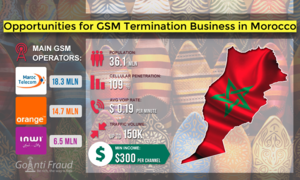
Opportunities for GSM Termination Business in Morocco
Morocco, a North African nation with a population of over 36.1 million people (as of the beginning of 2018), presents an enticing landscape for launching a GSM termination business. The combination of a sizable population and a well-developed mobile communication services market has led to significant inflows of voice traffic. As of today, mobile penetration in Morocco stands at 109%, translating to over 39.5 million connections. In this route, the average rate currently hovers around 14 cents per minute of call. Morocco's telecommunications market is among the most advanced on the African continent, boasting high penetration rates within the region. Currently, Morocco is served by three prominent GSM operators: Maroc Telecom (subscriber base: 18.3 million) Orange (subscriber base: 14.7 million) Inwi (subscriber base: 6.5 million) Maroc Telecom leads the Moroccan market, offering the best GSM coverage across the country. Orange and Inwi also provide good coverage but are more city-centric in their service areas. SIM cards in Morocco are readily available at prices ranging from $2 to $3 each, with operators frequently offering initial credit upon activation. You can acquire SIM cards at cellular operators' shops and various retail outlets. While branded shops may require you to present your passport for registration, street kiosks may offer SIM cards without such documentation. Given the current competitive rates in this sector, a GSM terminator can expect to earn at least $300 to $400 in Morocco from a single port of a GSM gateway for call termination. The more channels you engage in traffic landing, the higher your potential earnings. With Morocco's robust telecommunications market, favorable penetration rates, and attractive termination rates, the prospects for establishing a successful GSM termination business are quite promising. Keep an eye on further developments in this dynamic market.
The Advantages and Benefits of Simboxing in Africa
Simboxing, also known as GSM termination, has emerged as a transformative technology in the telecommunications industry, particularly in Africa. This practice involves redirecting international calls through local SIM cards to bypass traditional routes, offering numerous advantages and opportunities for operators and service providers in the region. In this article, we will explore the advantages and possibilities of simboxing in Africa. Cost-effective Communication: Simboxing enables cost-effective communication by leveraging local SIM cards and routing international calls through them. This approach significantly reduces the expenses associated with international calling, making it more affordable for individuals, businesses, and organizations in Africa to connect with the rest of the world. By offering competitive rates and efficient call routing, simboxing plays a crucial role in bridging communication gaps and fostering economic growth. Enhanced Call Quality: Simboxing systems employ advanced technologies and intelligent call routing mechanisms, resulting in enhanced call quality for users in Africa. By optimizing the call path and leveraging high-quality network connections, simboxing helps deliver clear and reliable voice communication. This improvement in call quality contributes to better customer experiences, increased customer satisfaction, and improved overall communication infrastructure in the region. Revenue Generation Opportunities: Simboxing presents profitable revenue generation opportunities for telecom operators and service providers in Africa. Setting up simboxing infrastructure and offering termination services allow operators to leverage the growing demand for international calls and generate additional sources of income. Diversifying services enables operators to expand their business and increase profitability in a competitive market. Improved Connectivity: Simboxing significantly contributes to improved connectivity in Africa. Through efficient routing mechanisms and the utilization of advanced technologies, simboxing ensures seamless connectivity between local and international networks. This connectivity not only facilitates international communication but also opens doors for business collaborations, global partnerships, and economic growth in Africa. Simboxing has revolutionized the African telecommunications landscape, offering a range of advantages for operators, users, and the entire industry. From cost-effective communication and enhanced call quality to fraud prevention and revenue generation opportunities, simboxing has transformed the way people communicate. As Uganda realizes the power of simboxing, the future of telecommunications looks promising, bringing forth more opportunities and benefits for all stakeholders in this dynamic industry. GoAntiFraud Corporate Solution is an advantageous offer for GSM termination professionals! Complex solution for corporate customers will improve the profitability of your business many-fold! You will have professional advice from technical experts GoAntiFraud, tools for efficient protection against the SIM-block, SBO traffic optimization and other capabilities of the service at your disposal.

What is the Difference Between VoIP and SIP?
In the enterprise world, practically every technology comes with an avalanche of acronyms. Take telephony for instance. Not many people know what exactly PSTN, PRI, ISDN, VoIP, SIP, etc. mean. Sure, you may have a vague idea that it is used somewhere in the office. But few people have a better idea than that. So it’s not surprising that one of the most commonly asked questions is – what’s the difference between VoIP and SIP? To an industry expert, the difference is glaringly obvious. For an amateur, not so much. It often seems that vendors use them interchangeably but they also refer to different things. Before you decide on a particular system for your business, take a few moments to understand the terms VoIP and SIP. VoIP vs SIP When people ask about the difference between VoIP and SIP, they usually want to know which one to use. What is better for their company? Unfortunately, comparing VoIP and SIP is ineffective. That’s because they’re referring to completely different things. WHAT IS VOIP? VoIP stands for Voice over Internet Protocol. In short, it refers to any technology that allows voice signals to travel over the Internet. It can also be called broadband telephony, Internet telephony, and many other names. It doesn’t matter what technology you use or the hardware and software. Remember that if a voice call travels over the Internet, it can be called VoIP. WHAT IS SIP? SIP stands for Session Initiation Protocol. A protocol is a system of digital rules that allows devices to talk to one another. Think of it as a language for computer hardware. If your computer and modem don’t speak the same language, they cannot communicate. SIP is simply one of many protocols that can be used to implement VoIP. It is used to set up and terminate multimedia sessions, including voice and video. At present, it is the most widely used protocol and is the industry standard. Perhaps when users are trying to figure out what VoIP is, the industry standard of using SIP with VoIP is why many people get confused between the two. SIP is almost ubiquitous in the industry. The Relationship Between VoIP and SIP Now that you know the specifics of what VoIP is and what SIP is, it’s time to understand how they relate to one another. It is similar to the relationship between websites and HTML. A website is a collection of pages that is accessible with a web browser. HTML is one language that you can use to build websites. However, most websites also use other languages such as Java. Similarly, VoIP refers to any method of sending voice calls over the Internet. That means everything from Skype and FaceTime to enterprise phone services fall under the same umbrella. SIP is just one of the many protocols currently in use. So, you can implement VoIP with other protocols as well. For example, Skype does not use SIP. But most enterprise-level phone systems rely on it. In other words, not every VoIP system will use SIP. But the vast majority of VoIP services do utilize it since it is the industry standard. If you have any further questions about what VoIP is or the benefits of using SIP with your VoIP system, contact us and we would be happy to help!

A unique opportunity to open your business for IT workers.
If you have experience and knowledge in the field of IT, and you are reading this article, then it is definitely time for you to change your life and start your own profitable VoIP business in the field of communications. Actually, anyone can start a successful GSM termination business, but if you have experience in the IT field, this is definitely an advantage. As you know, GSM termination is a successfully developing, profitable business in the telecommunications market, which is certainly related to the IT-sphere. We constantly use GSM networks to communicate with each other, and every year the number of such calls becomes more and more, so we can conclude that the business is profitable, in-demand every day, and constantly growing. Therefore, VoIP business in the IT field can become an ambitious and successful business project for you. So, what is needed to successfully launch VoIP GSM termination? Special equipment (GSM gateways, Sim banks) A place with internet and electricity where this equipment can be placed. Sim cards of local GSM operators Time to configure and monitor the system Knowledge of how to set up logic If you work in IT, or already have a business in this area, it's time to think about expanding opportunities and use your experience to start a business in GSM termination, because knowledge in the field of IT will be a big plus. Don't miss your chance. GoAntiFraud offers ready-made packages for starting a business, including equipment, special software, 24/7 technical support. It is easier and faster to start GSM termination and earn with us. Write in chat or leave a request on the website to get advice.

VoIP termination - profitable business or fraud?
Ten years ago, the VoIP business was a small startup, today it has become one of the most profitable niches in the telecommunications area. If you have a GSM gateway and Sim box, you will be able to earn well. Mobile operators, in turn, lose profit and fill the media space with custom articles that GSM terminators illegally interfere with the telecommunications systems. Thus, they contribute to the creation of a negative image of GSM termination. Let's figure it out, is GSM termination a simple cheating or a profitable business based on technological innovation? Every aspiring businessman is primarily income-oriented. So, the business in the field of GSM termination is no different from any other IT project. We often encounter negative reviews about this business on the Internet, and there are two reasons why it’s happening: Unsuccessful business start-up experience. Negative articles ordered by GSM carriers. As for people who could not successfully launch in this business, they seek to compromise GSM termination because they failed. Such people are found in any area of business. They did not seriously approach this issue and as a result, burned out. Luck does not come by itself, you need to work on it, therefore, with a sufficient investment of resources in this business, success is guaranteed. As for the custom articles of GSM operators, everything is simple here - technologies that use GSM termination simplify communication between people and make it cheaper. We are mainly talking about international calls. After VoIP gateways began to be located around the world and transfer calls over the Internet, GSM operators were forced to reduce their tariffs and lose profit. Therefore, such articles began to meet about "fraudsters and terminators," the purpose of which is to discredit terminators and get back a monopoly on communication and at the same time return high tariffs. GSM termination is a profitable business that makes communication cheaper and people closer. Do not pay attention to such "articles," the purpose of which is to confuse and close the opportunity for you to start a profitable business in the field of GSM termination, especially since our company makes this possible for everyone right now. We offer fully proven and operational tools for profitable VoIP GSM termination. We are an official authorized partner of the manufacturer of GSM gateways GoIP, provide technical support to the business in 24/7 mode and provide customers with contacts of verified partners who supply voice traffic. Also, each client has attached a personal account manager - he helps to understand all the intricacies of working with the service.

How does the international mobile system work?
VOIP GSM call termination business is based on the management of incoming international calls which are coming (landing) to your country. To make it clear for you, let's illustrate the call connection process with a very simple example Imagine that a person living in the USA (for example) is calling another person who is located in your country. The mobile network companies in each of these countries are different and most often don't even know each other. This means the mobile network company in the USA does not have a direct connection with the Mobile network company in your country. To connect the call to your country, the mobile network in the USA needs to use intermediary international call transit companies named "Transit operators" or "Call traffic providers" or "Originators".The "Transit operator" is a company that has very sophisticated software and hardware which allow calls transfer from one country to another country. Such companies are independent (private), and each of these transit companies participating in the international call connection process makes margin profit for each minute of call that they have transferred to any country; Finally, the mobile network company in the USA finds some international call transit operators which have reliable connections with your country then forward the call to them. From this step the Call transit operator has 2 options : 1st option: Connect the call directly to the official route through your local mobile network and then make a low-margin profit. 2nd option: Connect the call to the alternative route through VOIP GSM CALL TERMINATION BUSINESS (Means through you in case you start this business) and make a high profit As an independent (private) company has the goal to maximize their margin profit, most of the international call transit companies prefer the 2nd option. This means they prefer to deal with businessmen like you who are starting VoIP call termination, to build with you a WIN-WIN business corporation. Indeed when the call reaches your equipment (with goantifraud software) installed in your country, the system automatically converts the international call to a local call, then choose one of the sim cards that was inserted into the equipment and automatically forward the call to the callee (the person living in your country). For each minute of such call passing through your system, you will get paid in USD currency.
Why not become a mini GSM operator?
To get started, you will need equipment (not like that of a mobile operator) such as GSM gateways, Simbank, SMS server, SIM server, Remote control server, Internet connection, technical support, local SIM cards, and voice traffic from transit companies. To start a business, you will need to install all the equipment and insert SIM cards into the slots of your equipment. The traffic provider (transit company) will send voice traffic to your equipment. Calls directed to your equipment will be from different people from different countries. When a call reaches your equipment, our system automatically uses one of your SIM cards to land the call locally. When voice traffic passes through your SIM cards, you will receive for every minute of ground traffic. For new customers (who most often come without understanding and knowledge about business and without experience), we offer a number of turnkey solutions, so-called business packages, combining the main components for starting: equipment (we buy from partners in China), software, consulting and technical support (our services) and traffic (established partnerships with a number of traffic providers (transit companies)). GoAntiFraud earns money by selling licenses and subscriptions (in packages and outside of them) to customers and selling equipment (outside of packages). Therefore, a stable client is our interest.

GSM termination for dummies: how not to give Antifraud a chance
GSM termination is your chance to run your own remote business, which does not provide for physical contacts either with clients or partners. That is, it is an ideal option in case quarantine reoccurs or crisis occurs. Also, termination is an opportunity to make money in times of crisis, since people always call each other, which means you will always have profit. But terminators have an enemy - antifraud, which operators use to prevent termination. Special systems block SIM cards and therefore, entrepreneurs lose money and often burn out. The desire of GSM operators to block terminators’ SIM-cards is understandable because you "bite off" a part of their profit, and a considerable one. Fortunately, there are special tools to combat anti-fraud. Such tools are provided by the GoAntiFraud service designed for effective termination. Here's what you can do with the tools fighting the SIM block: Create scenarios for the behavior of SIM cards in order to simulate human behavior (so that it seems that a real person is calling, not a gateway). Set up a call schedule so that it looks as if a real subscriber is using the SIM-card (people have different activity at different times of the day, there are pauses between calls, etc.) Generate incoming traffic (after all, real people not only call but also receive calls). Make USSD requests (real subscribers check the balance, activate bonuses). Change the IMEI number of the gateway (since each mobile phone has its own unique name, and if many SIM cards work in one device, the operator immediately understands that this is a gateway). These and other opportunities provided by the GoAntiFraud service leave no chance for anti-fraud systems. Of course, this is not a panacea, but the number of blocked cards decreases noticeably, which has a positive effect on the terminator's profit. Still have questions? Leave an application and we will contact you for a free consultation.
Starting remote business in GSM termination: step by step guide
While doctors are saving people from the coronavirus, others are trying to secure their savings, which suffered during the pandemic. The best way to improve your financial situation is to start your own remote business, which brings stable income even in times of crisis. GSM termination is a vivid example of such a business, because all processes are carried out remotely, and there is always a demand for the product (in fact, you will sell a route to redirect calls, while people call each other even in the most difficult times). If you have already heard about this business, but you have no idea where to start, read the step-by-step instructions that we have prepared for you. Business is "in the box” Our company offers all-inclusive business packages to their clients. In fact, you buy a ready-made business solution, which you simply need to launch to start earning. Our "business in a box" includes everything you need to get started successfully: a set of necessary equipment; professional software for automation of business processes; tools to prevent SIM blocking (SIM block is the main problem faced by entrepreneurs in this business); round-the-clock technical support; personal account-manager consultation. Our experts will explain everything to you in detail, get you familiarized with the features of our service for GSM termination. You will only have to solve minor organizational issues before starting a business. 7 steps for starting a business Step 1: Choosing a business package for start. Our clients can choose one of four business packages, their prices start at $ 2000 (this money will pay off in a few months, and the minimum income will be $ 2000 per month). The packages differ in the number of channels that you plan to launch. Our managers will definitely advise you so that you decide which of the New Business packages is best for you. Step 2: Renting a room for equipment installation. It is important to place gateways for termination away from your immediate location. It is also recommended that the room is rented in a place where there are large flows of people (train stations, shopping centers, sleeping areas, etc.). It can be some kind of basement, not necessarily an apartment, that is, your costs should be minimal. Step 3: connecting Internet for equipment operation. For gateways to work stably, you need a high-speed Internet with a stable signal. It is important to take care of this in advance. Step 4: Buying SIM cards. To operate the equipment and land calls, you need SIM cards in large quantities. Find out in advance what are the conditions for buying new cards in the country where you plan to place gateways. Step 5: Connecting equipment to the service and setting up the termination logic. Connecting and configuring equipment to our service takes a minimum of time, our specialists will help you with this. Also, the company's experts will help you customize your business for the specifics of your country and build the logic for the most effective termination. Still have questions? Leave an application and our experts will contact you for a free consultation.